
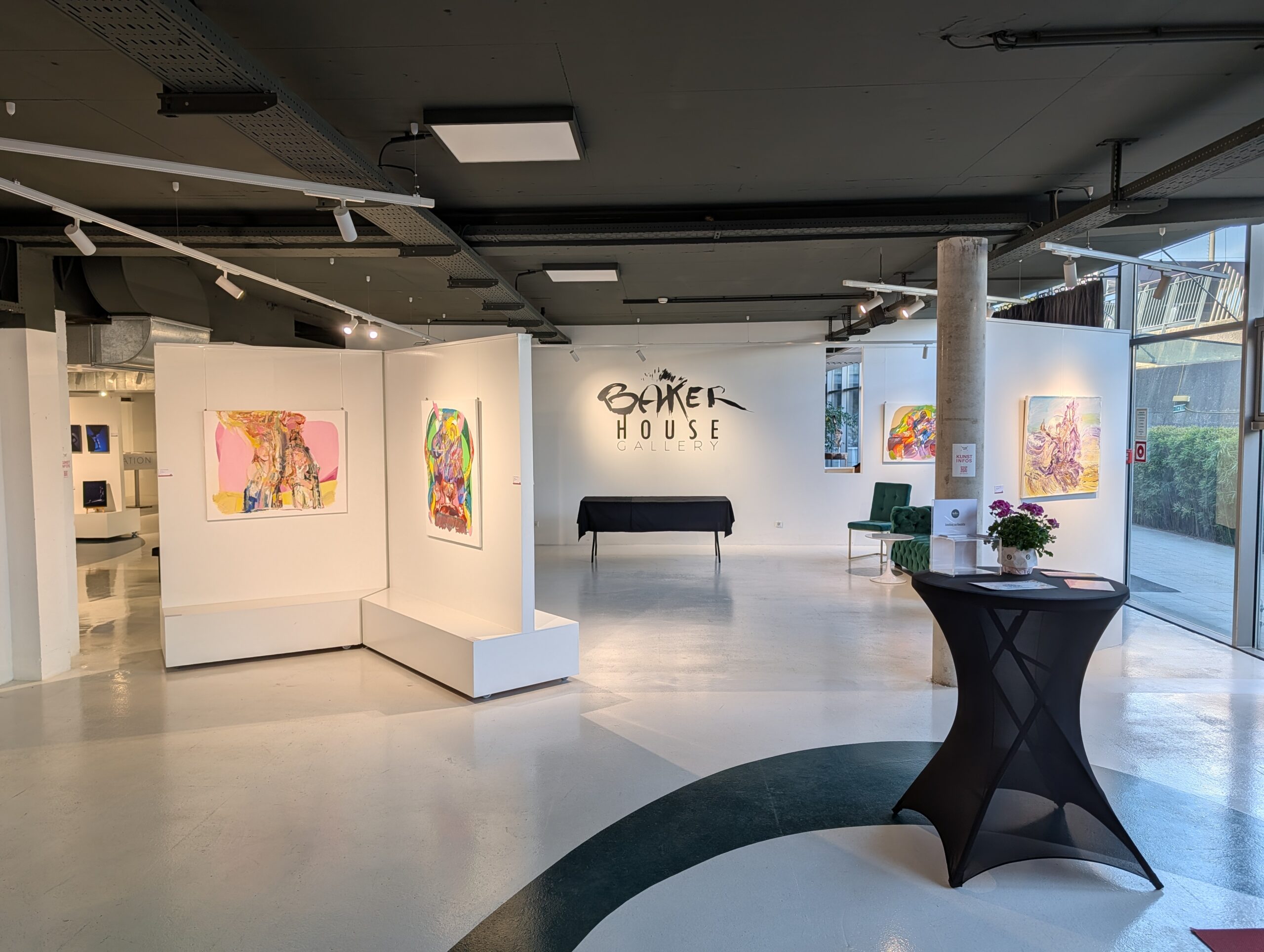
Ahead of the opening, I visited Bakerhouse Gallery in Graz to film a full walkthrough of the new exhibition EPIC WOMEN: in Bloom. My immediate impression was clear: this is not a symbolic group show built around a headline. It is a vivid, confident exhibition with real presence, strong visual rhythm, and a level of variety that keeps the viewer engaged from one room to the next.
Opening on April 10, 2026 at 6:00 PM, the exhibition brings together works by Irina Biatturi, Valentina Eberhardt, Seunghee Shin, Asma Kocjan, Lena Krashevka, Lucia Riccelli, Julia Scholz, Viktoria SG, Laura Stadtegger, Agostina Suazo, and Marika Thoms. Bakerhouse describes the show as a celebration of blossoming “in all its facets,” connecting the idea of bloom with visibility, courage, growth, and self expression.
That curatorial idea works because the exhibition does not feel narrow. Quite the opposite. What makes EPIC WOMEN: in Bloom so compelling is its range. There is color, atmosphere, softness, energy, gesture, and attitude. Some works feel intimate, others feel bold and declarative. Together, they create exactly what a strong gallery exhibition should create: a conversation between different artistic voices, not a flattening of them.
This matters, because exhibitions centered on women artists still carry real urgency in today’s art world. Progress is visible, but the gap has not disappeared. According to the Art Basel and UBS Global Art Market Report 2026, female artist representation reached 50% among primary market galleries and 45% across all dealers in 2025, while works by female artists accounted for 37% of sales by value. At the same time, disparities remain strongest at the upper end of the market.
The collector side is shifting too. Art Basel’s 2025 Survey of Global Collecting found that high net worth women spent 46% more on art and antiques than men in 2024, and nearly half of the works in women’s collections were by female artists. In the United States and Japan, that share was even higher. That is important context for a show like this: visibility is not only a cultural issue, it is increasingly a market issue as well.
And yet, structural imbalance is still part of the story. The National Museum of Women in the Arts notes that women remain underrepresented and undervalued across museums, galleries, and auction houses, even where the numbers have improved. In other words, exhibitions like EPIC WOMEN: in Bloom still do meaningful work. They do not simply “add” women artists to the calendar. They help shape how audiences, collectors, and institutions see artistic quality, relevance, and ambition.
What gives this show extra weight is its setting. Bakerhouse Gallery is no small white cube. The gallery states that it now spans more than 1,200 m² in Graz’s former slaughterhouse district, and the space has been developed into an immersive environment with flexible walls, a bar, and generous seating areas. That scale allows the works to breathe and gives the exhibition a public, event like energy that many galleries simply cannot offer.
Bakerhouse’s role in the Austrian art scene also helps explain why this exhibition matters. The gallery describes itself as Austria’s largest gallery for urban, contemporary, and street art, and its recent programming shows a reach that goes far beyond one local opening. Its calendar includes city editions in Vienna, artist talks, collectors evenings, fair appearances, and exhibitions in Klagenfurt, all of which point to a gallery with regional strength and national visibility.
Just as importantly, Bakerhouse has built a recognizable model: presenting promising talents alongside internationally known names. Recent exhibitions and fair presentations have paired Austrian and emerging artists with figures such as Ed Sheeran, Shepard Fairey, Banksy, Damien Hirst, Takashi Murakami, Ai Weiwei, and Yoshitomo Nara. That kind of positioning is powerful. It gives younger artists not only wall space, but context, credibility, and collector attention.
There is also evidence that this platform can translate into real momentum. In 2024, Bakerhouse reported that the scan.art Emerging Artist Prize exhibition brought together 24 up and coming artists from 20 countries, attracted more than 200 visitors on opening night, generated several art sales, and helped send featured artists on to further presentations at Discovery Art Fair Frankfurt 2024 and World Art Dubai 2025. That is exactly the kind of pathway emerging artists need: visibility, sales, and the next stage.
This is why EPIC WOMEN: in Bloom feels bigger than a seasonal opening. It is part of a broader pattern at Bakerhouse Gallery: building exhibitions that are visually accessible, socially relevant, and commercially alive. The gallery understands that audiences want quality, but they also want atmosphere, discovery, and connection. In Graz, Bakerhouse has become one of the rare spaces that can combine all of that.
For visitors, collectors, and anyone following the Austrian contemporary art scene, this exhibition is worth seeing. It is energetic without becoming chaotic, curated without feeling rigid, and diverse without losing coherence. Most of all, it gives female artistic voices the scale, confidence, and visibility they deserve.
If EPIC WOMEN: in Bloom is any indication, Bakerhouse Gallery continues to prove that championing women artists is not a niche gesture. It is smart curatorial work, strong market positioning, and a necessary contribution to what a serious contemporary gallery should be in 2026. For more information – visit www.bakerhousegallery.com