
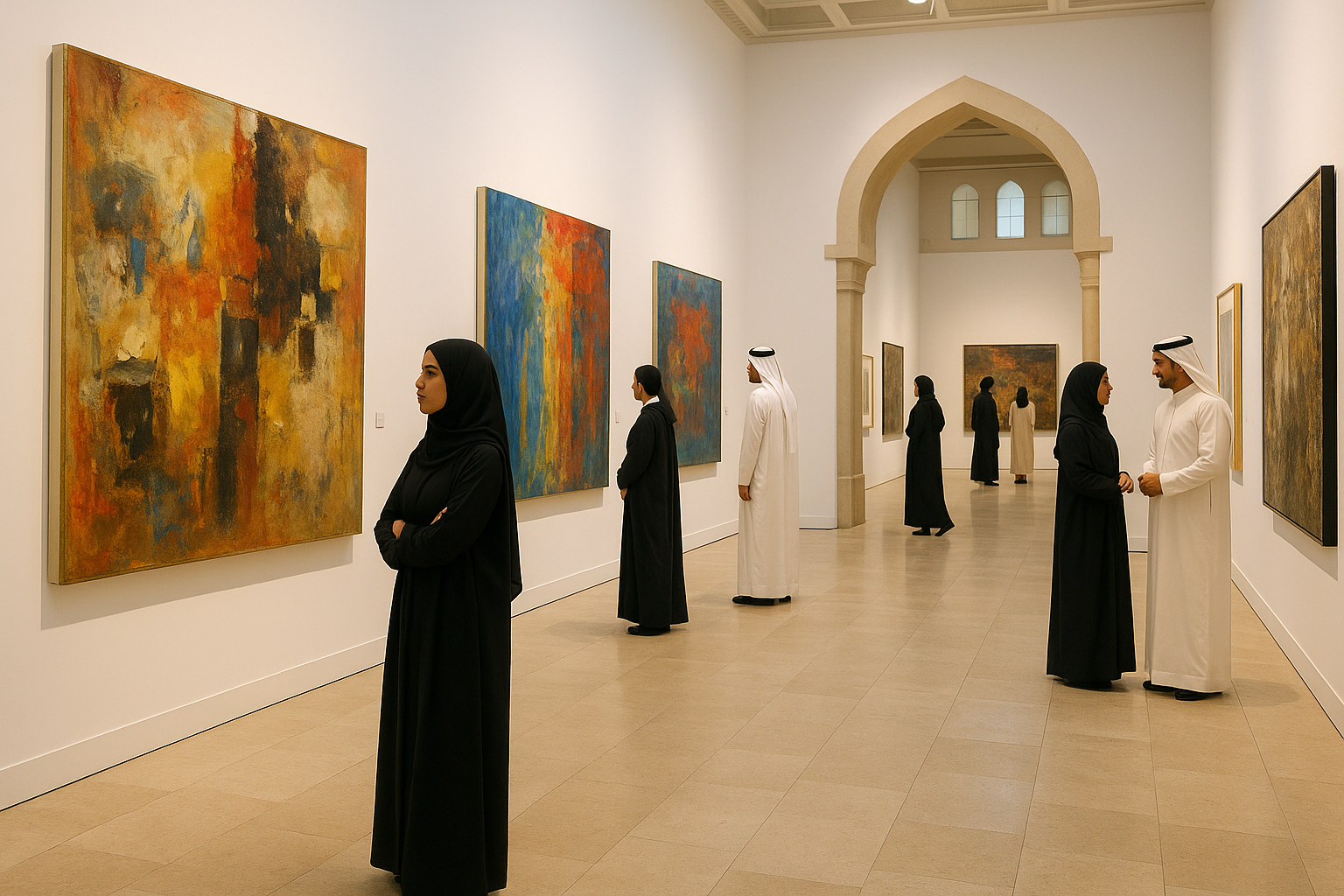
Over the past decade the Middle Eastern art market has shifted from “emerging” to “essential”. While global art sales fell about 12 percent in 2024 to 57.5 billion dollars, the region continued to build museums, launch new fairs and attract international capital, even though it still represents less than one percent of total turnover.
At first glance this might look like a contradiction. In reality it is a structural repositioning. Governments in the Gulf have identified culture as a strategic economic sector. A young, highly connected population is demanding more art, more events and more public space. Global brands from Art Basel to Design Miami are following that shift, embedding themselves in Doha and Dubai as if it were the most natural thing in the world.
This is how the Middle Eastern art market is evolving, and what it means for artists, galleries, fairs and collectors.
1. Growth by numbers: from niche to investment story
Several indicators show how quickly the Middle Eastern art market is maturing.
-
Auctions
A ten year study of modern and contemporary art auctions in the MENA region shows that sales grew about 30 to 40 percent between 2013 and 2023, despite short term volatility in 2024.
Christie’s reports that sales of modern Middle Eastern art tripled in value between 2020 and 2024.
In London, contemporary Middle Eastern art sales rose 89 percent in the first quarter of 2025, with New York auction houses reporting a 67 percent jump in consignments of Middle Eastern works. -
Art related tourism
A recent market analysis estimates that art linked tourism in the Middle East and Africa generated more than 3 billion dollars in 2024, with projections of 3.6 billion dollars by 2030. The same report notes that the UAE alone has invested around 5.3 billion dollars in arts and culture infrastructure. -
Creative economy contribution
Dubai’s creative industries contributed 21.9 billion dirham (about 6 billion dollars) to GDP in 2022, representing 4.6 percent of the city’s economy and supporting more than 175,000 jobs.
At the national level the UAE wants cultural and creative industries to reach 5 percent of GDP by 2031. -
Saudi cultural investment
Saudi Arabia has invested more than 81 billion riyal in museums, venues and large scale cultural events, the largest cultural infrastructure investment in its history.
Since the launch of Vision 2030, total spending on cultural projects has exceeded 21.6 billion dollars, with a target for culture to contribute 3 percent to GDP by 2030.
These numbers matter because they show something very simple: even while the global art market cools, governments and investors in the Middle East are still building.
2. Museum mega projects and cultural ecosystems
The most visible sign of this shift is in the region’s museum landscape.
United Arab Emirates: from Sharjah to Saadiyat
The UAE has moved from a few pioneering institutions to a complex museum ecosystem.
-
Louvre Abu Dhabi
Louvre Abu Dhabi welcomed 1.42 million visitors in 2024, its highest yearly attendance so far, and has now received more than 6 million visitors since opening in 2017. International visitors account for about 84 percent of the audience, confirming its role as a global destination. -
Sharjah Museums Authority
Sharjah Museums Authority now manages a network of around 16 to 17 museums, spanning Islamic art, modern and contemporary art, archaeology, science and maritime history.
This density of institutions in one emirate creates a museum cluster that feels more like a European cultural district than a traditional regional city. -
Dubai’s cultural infrastructure
Dubai has positioned itself as a creative economy hub, with mega projects such as the Museum of the Future and Expo City drawing international attention and cultural programming.
Alongside marquee venues, smaller institutions and arts districts like Alserkal Avenue host galleries, project spaces and foundations that anchor the city’s contemporary scene.
Qatar: museums as a national brand
Qatar has treated culture as a core part of its global strategy.
-
Qatar Museums network
Qatar Museums is a state entity overseeing museums, heritage sites, exhibitions and public art, and it used the 2022 FIFA World Cup as a large scale cultural showcase for Qatar and the wider Arab world. -
New museums on the horizon
The planned Art Mill Museum in Doha, due to open around 2030 on a former industrial flour mill site, is conceived as a major international museum for modern and contemporary art.
At the same time, an immersive exhibition on MF Husain anticipates a dedicated museum, “Canvas and Pen”, that will house more than one hundred of his works, underlining Qatar’s long term commitment to major artists. -
Dense programming
Regular exhibition seasons at institutions such as Mathaf and the National Museum of Qatar keep both residents and visitors engaged throughout the year.
Saudi Arabia: heritage and future in parallel
Saudi Arabia’s museum and heritage strategy is deeply linked to Vision 2030.
-
Vision 2030 and cultural venues
The Vision 2030 blueprint explicitly calls for libraries, arts venues and museums that support social cohesion and create jobs. -
Diriyah and AlUla
Diriyah, the historic birthplace of the Saudi state, is being developed as a cultural city with museums and public art, supported by the Diriyah Biennale Foundation.
AlUla, another flagship heritage site, plans to offer investment projects worth around 1.6 billion dollars, targeting about one million visitors a year by 2030, with roughly 70 percent currently coming from the Gulf. -
Noor Riyadh and city scale art
Noor Riyadh, the yearly light art festival, has grown into the largest light art platform in the world, presenting more than 450 works by 365 artists over recent editions.
The 2025 festival drew a record seven million visitors and won twelve international awards, setting several Guinness World Records and positioning Riyadh as a global hub for light based art.
In short, museums and citywide events are no longer symbolic trophies. They are active engines for tourism, education and soft power.
3. Art fairs and biennales: the Gulf as a global meeting point
Fairs and biennales have become the main interface between the Middle Eastern art market and the rest of the world.
Art Dubai and the UAE fair ecosystem
Art Dubai has turned Dubai into a fixed point on the global fair calendar.
-
The 2025 edition hosted more than 120 galleries from 65 cities, including a strong contingent of local and regional galleries, and is widely described as the leading fair in the Middle East.
-
Recent editions have attracted over 30,000 visitors over five days, underlining its growing international pull.
-
The fair has also built a large education programme for children and young people, signalling a long term investment in audiences, not only sales.
Alongside Art Dubai, Abu Dhabi Art has become a significant platform, with the 2024 fair hosting more than 100 galleries from 31 countries and mixing modern Middle Eastern artists with global contemporary names.
World Art Dubai, positioned as the most accessible fair in the UAE, expands the buyer base by offering affordable works and live programming for a wider public.
Qatar: Art Basel enters the region
The most symbolic development is the launch of Art Basel Qatar in Doha in February 2026.
-
The fair will host about 84 artist presentations by 87 galleries at M7 in downtown Doha, focusing on modern and contemporary art from the Middle East, North Africa, South Asia and beyond.
-
Art Basel’s leadership has described the fair as a “multi dimensional partnership” with Qatar Museums and Qatar Sports Investments, and a strategic move during a global market downturn.
When the world’s most influential fair operator chooses the Middle East for its first new event in years, it signals that the region is no longer peripheral but central to future growth.
Saudi Arabia: biennales and festivals
Saudi Arabia has taken a biennale and festival driven approach.
-
The Diriyah Contemporary Art Biennale and the Islamic Arts Biennale provide a recurring platform for local and international practitioners.
-
Noor Riyadh has become a global reference point for experiential public art and is tightly integrated into city branding and tourism strategies.
Together these events create a dense calendar that encourages galleries and collectors to spend more time in the region, rather than simply flying in for one fair.
4. Galleries and collectors: a new generation takes the lead
An art market needs dealers and buyers, not only institutions. Here the Middle East has changed dramatically.
A maturing gallery ecosystem
In the UAE, galleries such as The Third Line, Green Art Gallery and Lawrie Shabibi have developed strong international reputations, representing regional artists at major fairs and in museum shows.
In Dubai, Tabari Artspace has championed modern and contemporary Middle Eastern art since 2003 and is now described as being at the forefront of the regional scene, with a mission to promote MENA artists globally and amplify under represented voices.
In Saudi Arabia, Athr Gallery, founded in Jeddah in 2009 and now present in Riyadh and AlUla, is recognised as a leading contemporary art gallery shaping the national scene and investing in storage and logistics infrastructure for collectors.
These galleries are more than showrooms. They commission new work, structure residencies, help artists navigate international fairs and maintain relationships with institutions. Over time they have created a professional market infrastructure that did not exist two decades ago.
Younger, tech savvy collectors
Equally important is who is buying the art.
-
In a recent interview, a major auction house executive noted that 58 percent of new buyers and bidders in the Middle East are millennials or younger, significantly higher than in other regions. Saudi Arabia itself has an extremely young population, with around 63 percent under the age of thirty.
-
Studies on Gulf collectors suggest that the region has become a prominent hub for collecting, where art functions as an expression of identity and history, not just as an asset.
-
A recent market report highlights that a new generation of collectors in the UAE, Saudi Arabia and Qatar is focused on regional artists and on aligning collections with personal and cultural narratives, often supported by digital research and online platforms.
This younger cohort is comfortable discovering artists on Instagram, buying at fairs and bidding online, which supports both primary and secondary markets across borders.
5. Rising local demand for culture
A striking feature of the region’s cultural boom is that many visitors are local or regional, not only tourists.
-
Louvre Abu Dhabi’s audiences are majority international, but a significant part of its education programming targets UAE residents and school groups, and repeat visits are common.
-
Noor Riyadh’s seven million visitors were largely residents of Riyadh and the wider Kingdom, turning a citywide festival into a recurring social ritual.
-
At AlUla, about 70 percent of visitors are from Gulf countries, reflecting strong regional travel and interest in heritage.
Government strategies reinforce this. Saudi Arabia’s National Strategy for Culture and the UAE’s creative industries plan treat culture not only as export, but as a way to improve quality of life, create jobs and diversify economies away from oil.
The result is an audience base that is younger, more regional and more active than stereotypes would suggest.
6. Challenges and questions that remain
None of this means the Middle Eastern art market is easy or risk free.
-
The region is still affected by geopolitical tensions, which can disrupt logistics, tourism and investment cycles. Recent analyses show that conflict can both displace collectors and increase demand for works dealing with themes of war and displacement, especially in London and New York sales.
-
The global downturn in high value auctions has not spared Middle Eastern collectors, even though Gulf based funds and sovereign investors are stepping into ownership stakes in major auction houses and cultural assets.
-
Debates around labour rights, censorship and freedom of expression, especially in connection with mega events and new fairs, are intensifying. The launch of Art Basel Qatar, for example, has already sparked scrutiny of human rights issues in the host country.
For artists, galleries and institutions, this means that due diligence, ethical positioning and long term relationship building are essential.
7. What this means for artists, galleries and fair organisers
For artists, the Middle Eastern art market offers:
-
more residency programmes and institutional shows
-
access to a young collector base that is open to experimentation
-
opportunities to work at urban scale through public art and festivals
For galleries, it offers:
-
a dense fair calendar (Dubai, Abu Dhabi, Doha, Riyadh) that can anchor a broader regional strategy
-
the chance to work with governments, corporates and foundations that are still building their collections and patronage models
For art fair and exhibition organisers, it is:
-
a test bed for new formats that blend art, technology and entertainment
-
a region where city branding and cultural policy actively seek large scale events
If you are planning to enter the Middle Eastern art market as an artist, gallery or organiser, it is worth treating it as a long term partnership rather than a one off opportunity. Consistent presence at fairs, strategic collaborations with local institutions and a clear understanding of cultural policies in each country are the best starting points.