
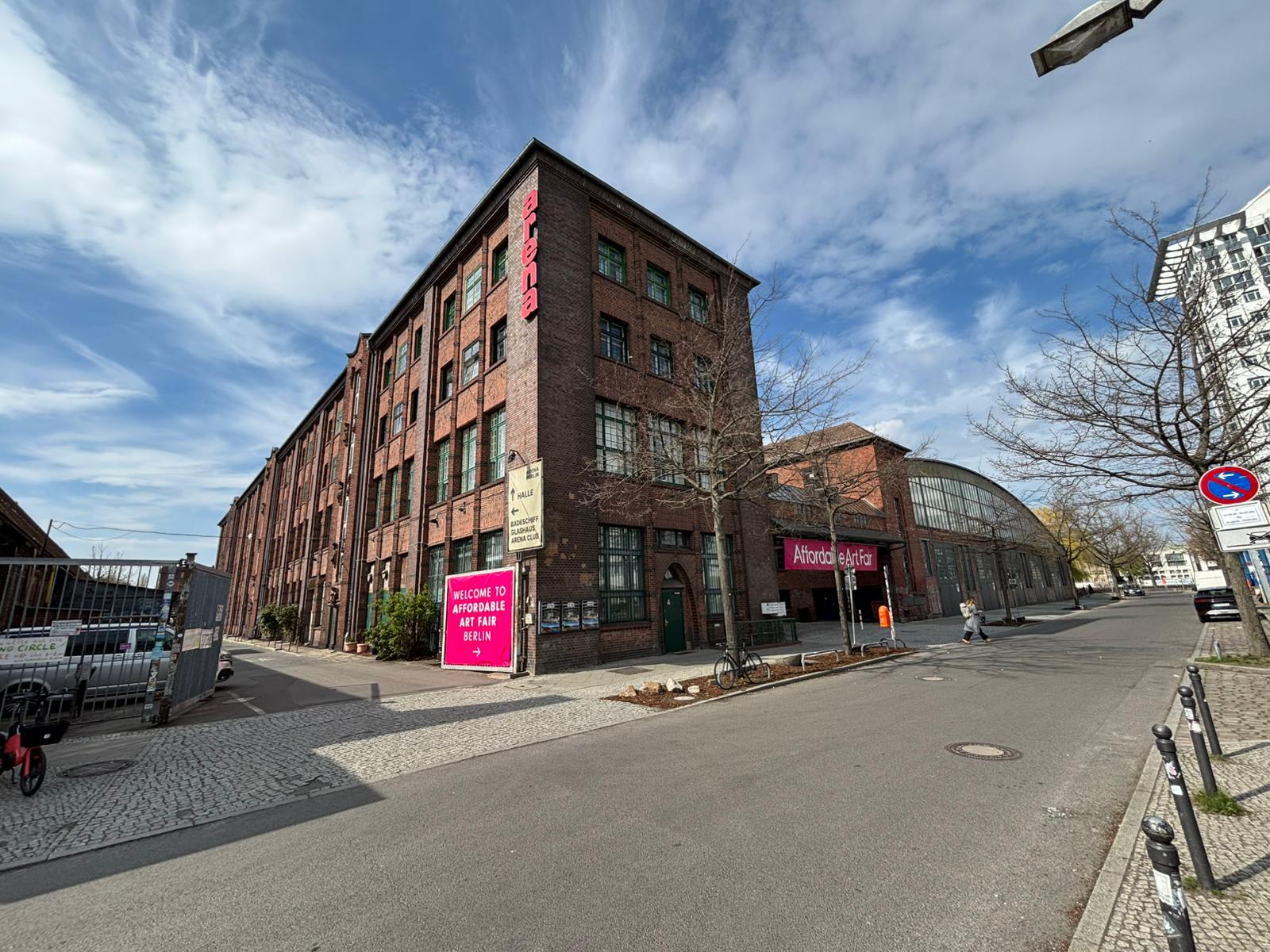
Affordable Art Fair Berlin 2026 felt familiar in the best possible way.
After visiting the inaugural Berlin edition in 2024, it was genuinely enjoyable to return to Arena Berlin and see how the fair has settled into the city. The Berlin edition officially launched in April 2024, and this year marked its third outing at Arena Berlin. For 2026, the fair returned from 16 to 19 April with more around 65 galleries and works priced between €100 and €10,000, continuing the core Affordable Art Fair promise of making contemporary art accessible to a broader public.
That mission still comes through clearly on site. Affordable Art Fair Berlin is not trying to be the most intimidating, blue chip, theory heavy event on the calendar. It is trying to make people feel comfortable enough to look, ask, compare, and buy. In a market where that first step into collecting still feels daunting for many visitors, that remains one of the fair’s biggest strengths. The positioning is intentional, and it works.
What struck me most this year was not dramatic expansion, but consolidation.
On paper, the fair has grown since its debut. The first Berlin edition in 2024 brought together 50 galleries from 15 countries, while the 2025 edition was presented with around 60 galleries from 19 countries. The 2026 edition moved that up again to more than 65 galleries. Still, from a visitor perspective, the fair did not feel radically bigger than before. It felt more refined, more established, and a little more confident, but not substantially transformed in scale. That gradual development actually aligns quite well with what I experienced walking the aisles.
And that is not necessarily a criticism.
Not every fair needs explosive year on year growth to prove relevance. In Berlin, a measured evolution may be the smarter move. Affordable Art Fair already has a clear proposition, a recognizable visual identity, and a strong venue in Arena Berlin. The location remains one of the fair’s real assets. The industrial architecture gives the event personality, and just as importantly, it feels like a site that can comfortably absorb future expansion. There is still room for the fair to grow into the building more fully.
In terms of artistic quality, the 2026 edition felt broadly comparable to 2024.
There was a solid, accessible range of painting, printmaking, photography, sculpture, and mixed media, and the overall level was consistent with what one would expect from the Affordable Art Fair model. A few booths and curatorial presentations stood out clearly from the rest, not because they were louder, but because they were better edited. The strongest presentations understood that clarity sells. They gave works room to breathe, created a focused mood, and avoided the temptation to overcrowd the stand.
That matters especially at a fair like this, where many visitors are not just browsing for cultural capital, but are actually trying to imagine a work in their home or office. A well curated stand makes that mental leap easier.
There also seemed to be a healthy amount of foot traffic on the days I visited. Official programming this year included daily public tours, curator led tours, a site specific entrance installation by Christian KERA Hinz, a collectors’ talk, a sculpture area, a family oriented interactive mural, and the Friday Late View. The fair clearly understands that a contemporary art fair today is not just about rows of booths, but about creating multiple access points for different visitor groups.
Sales, of course, are much harder to judge from the floor.
You can feel momentum, but you cannot reliably measure sell through by just walking around. Still, one visible signal stood out: quite a few visitors were carrying smaller works, editions, and prints. That does not tell the whole commercial story, but it does suggest that the lower price categories were moving. And that makes sense. Affordable Art Fair is built around transparency and accessibility, and in 2026 that strategy is supported by broader market signals too. In its new report with ArtTactic, Affordable Art Fair argues that the market below $50,000 is currently the most active and resilient tier, with growing confidence and more younger buyers entering the market. That wider trend gives fairs like this a strong tailwind.
One aspect that did stand out to me in a less positive way was the treatment of some exterior booth walls.
At several points, there were plain white outside walls between booths that appeared to have been left completely unused, presumably because galleries had not purchased or programmed those surfaces. As a visitor, this was surprisingly noticeable. Instead of adding rhythm, orientation, or visual anticipation, those walls felt empty and unresolved. In a fair environment, blank space can be powerful when it is intentional. Here, it often felt more accidental than curated.
This is exactly the kind of detail that could make a real difference in future editions. Even simple interventions would help: gallery logos, artist names, teaser works, thematic graphics, collector guidance, sponsor integrations, or editorial signage. These are not huge structural changes, but they would make the fair feel more finished and better activated from a visitor experience perspective. When you are walking a fair, every wall communicates something. A dead wall communicates missed opportunity.
That said, the overall impression remained very positive.
Affordable Art Fair Berlin 2026 is a good fair in a very good venue, with a strong concept that continues to resonate. It may not have expanded dramatically since 2024, but it has clearly established itself. The fair knows its audience, understands the value of transparent pricing, and continues to position itself as an approachable entry point into contemporary collecting. This year’s programme, from guided tours to the entrance installation and family format, also showed that the organisers are thinking beyond simple booth rental and trying to shape a fuller visitor experience.
For Berlin, that matters.
There is room in the city for a fair that is less about spectacle and exclusivity, and more about access, confidence, and discovery. Affordable Art Fair Berlin is not trying to be everything to everyone. But within its lane, it is doing a lot right.
Now the next challenge is obvious: not just becoming bigger, but becoming sharper and improving the quality of presentations in some cases.
The foundation is there. The audience seems to be there. The venue certainly is. What comes next should be a stronger sense of spatial activation, even better stand presentation across the board, and a continued push to turn a good fair into a must visit one.
For now, Affordable Art Fair Berlin 2026 confirms something important: Berlin’s most accessible contemporary art fair is no longer the new kid on the block. It is becoming a fixture.
More information about AAF Berlin: https://affordableartfair.com/fairs/berlin/