
ANTARCTICA at Panometer Leipzig: Why Yadegar Asisi’s 360° Panoramas Are Among Europe’s Most Impressive Exhibition Experiences
Few exhibition formats manage to impress visitors before they have even fully entered the main room. The Panometer Leipzig is one of them.
Inside a former gasometer in Leipzig, artist Yadegar Asisi has created one of the most distinctive exhibition experiences in Europe: monumental 360° panoramas that surround visitors completely, combining painting, photography, digital composition, architecture, sound and light into a single spatial artwork.
The current exhibition, ANTARCTICA, is the latest chapter in this extraordinary panorama format. I visited the exhibition and filmed a full walkthrough, which you can watch here:
For anyone interested in touring exhibitions, immersive storytelling or large-scale cultural attractions, Panometer Leipzig is a must study. It shows how an exhibition can become more than a room filled with artworks. It can become a place, a journey and an atmosphere.
What is ANTARCTICA at Panometer Leipzig?
ANTARCTICA is Yadegar Asisi’s monumental 360° panorama dedicated to the Antarctic region. The exhibition had its premiere at Panometer Leipzig on 24 January 2026 and is currently announced to run until at least the beginning of 2028.
The panorama places visitors in front of the Antarctic ice sheet, using the waterline as a powerful visual perspective. Above the surface, glaciers, ice shelves and icebergs dominate the horizon. Beneath the surface, the hidden life of the Antarctic ocean appears, with whales, seals, penguins and marine ecosystems becoming part of the scene.
This is where Asisi’s panorama format becomes so effective. The visitor is not simply looking at a picture. The visitor is placed inside a constructed world. The scale, the viewing platform, the light and the surrounding image create the feeling of being physically present in a remote landscape that very few people will ever experience in real life.
A world of ice, light and silence
The strongest quality of ANTARCTICA is its atmosphere. The exhibition does not rely on spectacle alone. It works through scale, slowness and detail.
The colour palette is reduced, dominated by whites, blues, greys and deep shadows. This restraint makes the panorama even more powerful. It reflects the extreme character of Antarctica: beautiful, fragile, distant and almost unreachable.
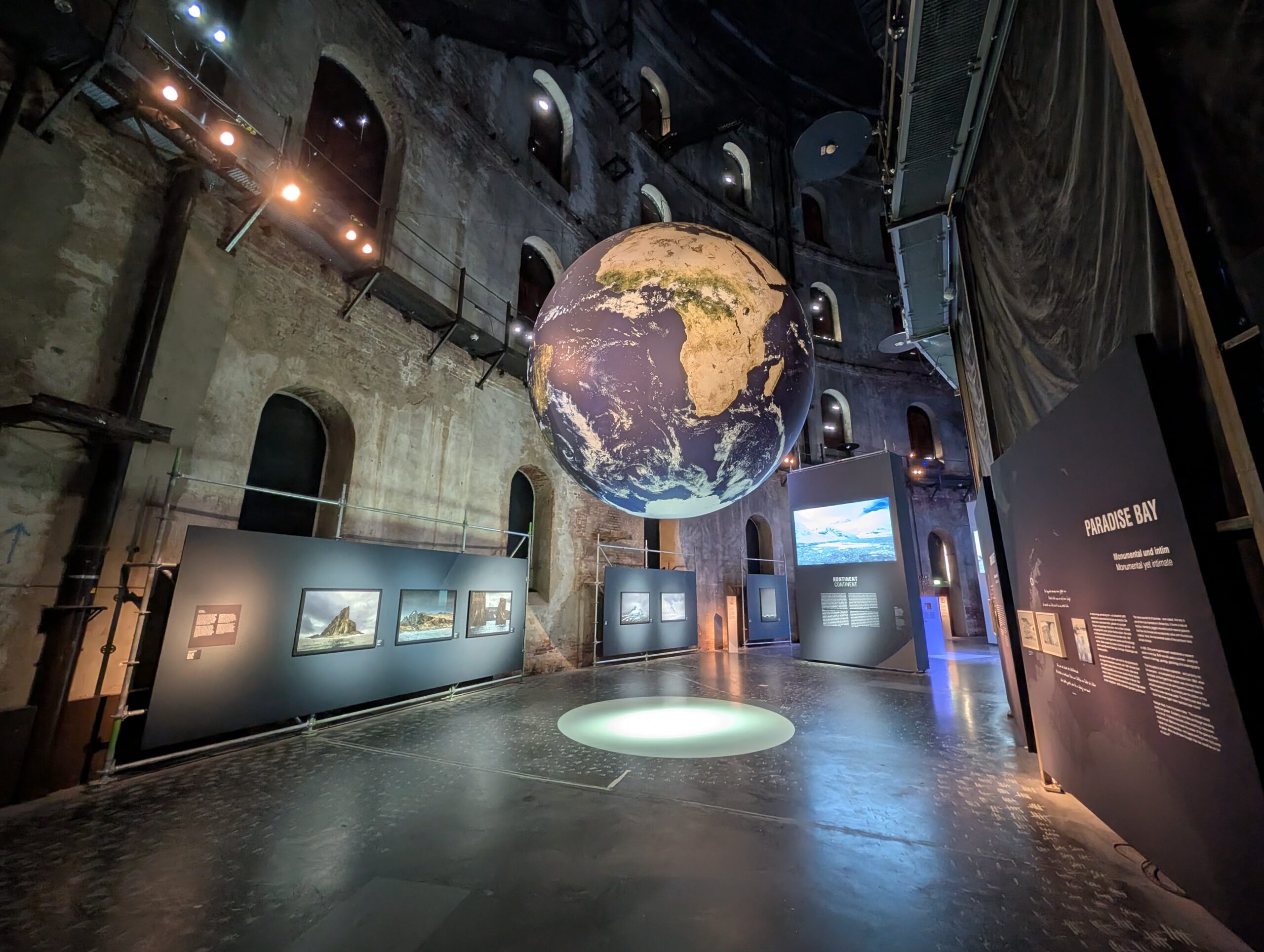
The accompanying exhibition adds context before visitors enter the panorama. It presents information about geology, climate, wildlife, research history and Asisi’s own artistic approach. Photographs, sketches, paintings and expedition material help explain how the panorama was developed and why Antarctica is such a complex subject.
Asisi travelled to the region in 2016, studying the light, ice structures and atmosphere on site. This research-based approach is one of the reasons his panoramas feel different from standard immersive exhibitions. They are built from observation, artistic interpretation and years of production work.
Why the Panometer format is so powerful
Many immersive exhibitions today use projections, screens and digital effects. The Panometer format follows a different logic. It is monumental, architectural and painterly.
Yadegar Asisi’s panoramas are 360° circular images with a height of up to 32 metres and a circumference of up to 110 metres. Visitors usually experience them from a central viewing platform, which allows the eye to move across the entire scene. The result is closer to entering a vast painted world than watching a film.
This creates a rare kind of visitor behaviour. People slow down. They look. They return to details. They discover small scenes, hidden figures, animals, buildings or atmospheric moments. The work rewards attention.
For exhibition organizers, this is one of the most important lessons of the Panometer model: scale alone is impressive, but detail creates duration. Visitors stay longer when they feel that the artwork keeps revealing itself.
Yadegar Asisi and the revival of panorama art
Yadegar Asisi has been central to the revival of panorama art in the 21st century. Born in Vienna in 1955, he studied architecture in Dresden and painting in Berlin. Since 2003, he has been creating some of the world’s largest 360° panoramas.
The story of the Panometer began in Leipzig with the project 8848 EVEREST, shown in a converted gasometer. The term “Panometer” itself combines panorama and gasometer, describing both the format and the building type that makes such an exhibition possible.
Since then, Asisi’s panorama projects have expanded across several locations in Germany, including Leipzig, Dresden, Berlin, Lutherstadt Wittenberg and Pforzheim. His subjects range from natural worlds to historical scenes and cultural landmarks.
Among the best-known panorama projects are:
- AMAZONIA, a journey into the rainforest
- GREAT BARRIER REEF, an underwater world of colour and biodiversity
- PERGAMON, a reconstruction of the ancient metropolis
- THE WALL, a view into divided Berlin
- LUTHER 1517, a historical panorama in Wittenberg
- LEIPZIG 1813, focused on the aftermath of the Battle of the Nations
- THE CATHEDRAL OF MONET, inspired by Monet’s famous Rouen Cathedral series
- ANTARCTICA, the latest major nature panorama in Leipzig
Together, these works show the extraordinary range of Asisi’s practice. His panoramas can be historical, ecological, architectural, political or poetic, while always remaining deeply spatial.
A benchmark for touring exhibitions
From the perspective of The Touring Exhibition Guy, the Panometer exhibitions are especially interesting because they show how a strong exhibition format can become a repeatable cultural model.
The Panometer concept combines several elements that are essential for successful touring and destination exhibitions:
- A strong central visual experience
- A clear visitor journey
- A memorable architectural setting
- Educational content before or after the main experience
- High emotional impact
- Strong media and video potential
- A clear identity across different locations
- A format that appeals to families, tourists, schools and culture lovers
This is the kind of exhibition that works across different audience groups. Art lovers can appreciate the painterly and technical achievement. Families can enjoy the accessibility and scale. Schools can use the exhibition as an educational entry point. Tourists can experience it as a city highlight. Exhibition professionals can study it as a model for long-running cultural attractions.
Why ANTARCTICA feels relevant now
ANTARCTICA arrives at a time when climate, ecology and the fragility of natural systems are central cultural topics. The exhibition does not present itself as a scientific documentary. It uses art to create awareness through emotion, space and wonder.
That is a powerful approach. Data can inform people, but experiences can stay with them.
By placing visitors inside the Antarctic landscape, the panorama creates a personal relationship with a region that is usually distant, abstract and inaccessible. It makes the remote feel close. It gives scale to something most people only know from documentaries, maps or news about climate change.
This is one of the great strengths of Asisi’s nature panoramas. They make environments visible in a way that is artistic, educational and emotionally direct.
My walkthrough video from Panometer Leipzig
I filmed a full walkthrough of ANTARCTICA at Panometer Leipzig to show the atmosphere, scale and visitor experience of the exhibition.
Watch the video here:
Of course, video can only give an impression. The real effect of the panorama comes from standing inside the space, looking up at the 32-metre-high image and slowly discovering the world around you.
Final thoughts: A must-see exhibition format
ANTARCTICA at Panometer Leipzig is a powerful example of how immersive exhibitions can be artistic, educational and emotionally memorable without losing depth.
Yadegar Asisi’s panoramas are a reminder that immersive art does not have to depend only on technology. It can also come from drawing, painting, research, storytelling, architecture, sound, light and the simple human desire to step into another world.
For visitors, Panometer Leipzig is a remarkable cultural experience. For exhibition organizers, it is a benchmark. For anyone interested in the future of touring exhibitions, destination experiences and large-scale visual storytelling, Yadegar Asisi’s Panometer exhibitions deserve close attention.
If you are planning an exhibition, art fair, immersive project or touring cultural experience and want to understand what makes formats like this successful, The Art Fair Guy and The Touring Exhibition Guy offer consulting for concept development, visitor experience, exhibition strategy and international positioning.
FAQ
What is ANTARCTICA at Panometer Leipzig?
ANTARCTICA is a 360° panorama exhibition by Yadegar Asisi at Panometer Leipzig. It presents the Antarctic landscape, ice formations and marine life in a monumental circular image.
When did ANTARCTICA open at Panometer Leipzig?
ANTARCTICA premiered at Panometer Leipzig on 24 January 2026.
How long will ANTARCTICA be shown?
The official Panometer Leipzig website lists ANTARCTICA as running until at least the beginning of 2028.
Who is Yadegar Asisi?
Yadegar Asisi is an artist known for creating some of the world’s largest 360° panoramas. His works combine painting, architecture, digital composition, photography, sound and light.
What is a Panometer?
A Panometer is a panorama exhibition shown inside a former gasometer or a similar circular building. The word combines panorama and gasometer.
Is Panometer Leipzig worth visiting?
Yes. Panometer Leipzig is one of Germany’s most impressive exhibition experiences, especially for visitors interested in immersive art, large-scale storytelling, natural worlds and touring exhibition formats.